
The single biggest reason puppies end up with months of indoor accidents isn't stubbornness. It's that their owners skip the structure. I've watched it happen over and over: a new owner brings home an eight-week-old puppy, gives them free run of the house on day one, and then wonders why the living room smells like a kennel by week three.
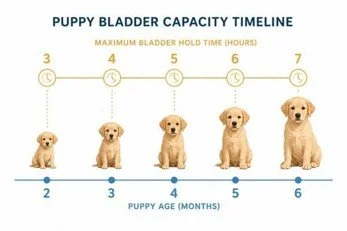
Puppy potty training is the process of teaching your dog where (and when) to eliminate by pairing a consistent schedule with positive reinforcement and supervision. Most puppies can be fully housetrained in four to eight weeks with daily consistency, though smaller breeds often take longer. Full bladder control typically doesn't develop until five to six months of age, so expecting a 10-week-old to hold it all night is setting both of you up for failure.
What follows here is a 10-step system for getting your puppy to reliably go outside, built from what actually works in the field, not what sounds clean on paper.
How Often Should You Take a Puppy Outside?
The general rule is that a puppy can hold their bladder for roughly one hour per month of age, plus one. A three-month-old puppy maxes out at about four hours. However, that's the ceiling, not the target.
When your puppy is awake and active, take them out every 30 to 60 minutes. CPDT-KSA certified trainer Irith Bloom recommended in a 2025 interview that puppies need breaks every 30 minutes during active play periods. That sounds extreme until you realize how small a puppy's bladder actually is. A 10-week-old toy breed might need to go every 20 minutes when awake.
This schedule applies at night as well. You will be getting up in the middle of the night for the first several weeks. Set an alarm. Don't wait for whining, because by the time a puppy cries in their crate, they've probably already had an accident or are seconds from one.
Fortunately, this phase is short. By four to five months, most puppies can sleep six to seven hours overnight without a break. However, rushing that timeline is how you end up cleaning your carpet at 3 AM.
Always Use a Leash During Potty Breaks
When you take your puppy outside for a potty break, leash them and walk directly to the same spot every time. Don't let them wander the yard sniffing everything. Don't turn it into playtime. The trip has one purpose: go to the bathroom.
Use a verbal cue like "go potty" or "do your business" the moment you reach the spot. Say it once (not five times), then wait quietly. The scent from previous visits will help your puppy associate the location with elimination. The structure does the teaching for you. After they go, that's when you celebrate. Praise, treat, and then a few minutes of off-leash play if you want, but the reward comes after the business, not before.
Reward Every Successful Trip Outside
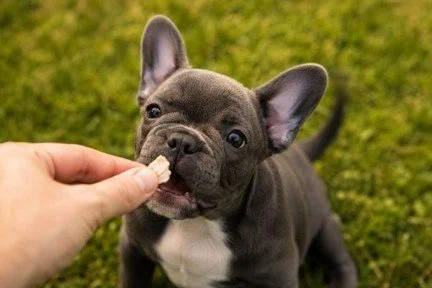
Every single time your puppy eliminates in the right spot, reward them immediately. Use high-value treats: small pieces of cooked chicken, cheese, or freeze-dried liver. The ASPCA's housetraining guidelines recommend "lavish praise and treats" for successful outdoor elimination, and they're right. You want your puppy's brain to light up every time they go to the correct spot.
For middle-of-the-night trips, keep it low-key. A quiet "good dog" and a small treat. You don't want to rev them up at 2 AM with an excited party voice. The goal at night is quick business, quick reward, back to the crate.
What Are the Signs Your Puppy Needs to Go?
Every puppy has tells, and the most common ones are:
Sniffing the ground in circles
Pacing toward the door
Suddenly stopping play to squat
Whining and looking restless
Your job during the first few weeks is to become a student of your puppy's body language. If they sniff and circle near the couch, grab the leash and get outside. A 2024 APDT International survey of professional trainers found that lack of supervision was the second most cited reason (after inconsistency) for prolonged housetraining failures.
Write down what you notice. Keeping a simple log of when your puppy eats, drinks, and eliminates (and what signals preceded it) will reveal patterns within the first week. Some owners track this in an app. A notebook works just as well.
Never Punish a Puppy for Accidents
Your puppy has zero ability to connect your anger right now with something they did 10 minutes ago (or even 60 seconds ago). The ASPCA's housetraining guidelines are clear on this: punishment for accidents creates fear, not learning.
What actually happens when you punish: your puppy learns that eliminating in front of you is dangerous. So they start hiding it behind the couch, in the guest bedroom or iIn the closet. Now you've got a "stealth pooper" who is harder to train, not easier.
If you catch your puppy mid-accident, calmly interrupt them (a quick "oops" or hand clap), scoop them up, and get them outside to the designated spot. If they finish outside, reward them. That's the teaching moment.
How Should You Clean Up Indoor Accidents?
With an enzymatic cleaner, every single time. Regular household cleaners won't cut it. Your puppy's nose is roughly 10,000 to 100,000 times more sensitive than yours (depending on the breed and study you cite). If any trace of urine scent remains, your puppy reads that spot as an approved bathroom.
Enzymatic cleaners break down the proteins and pheromones in urine that signal "go here again." Follow the product instructions exactly. Most require you to saturate the spot, not just spray the surface, and let it sit for 10 to 15 minutes before blotting.
I you've been cleaning accidents with regular soap or vinegar for weeks before switching to enzymatic cleaner, the scent markers are already layered deep into carpet padding or wood grain. You might need to treat the same spot two or three times to fully eliminate it. I've seen owners go through months of frustration because they cleaned the surface but never addressed what had soaked into the subfloor.
For hard floors, it's simpler. Enzymatic cleaner, wipe, done. But check grout lines. Urine gets into the grout and stays there.
Build a Daily Routine Your Puppy Can Predict
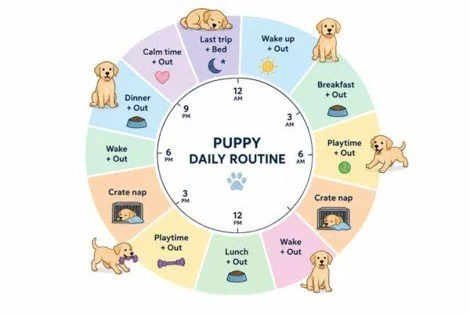
Puppies need to go at predictable times: right after waking up, right after eating, right after playing, and right before bed. If you build a daily schedule around those triggers, you'll catch 80% or more of your puppy's elimination needs before they become accidents. Here's what a realistic schedule looks like for a 10-week-old puppy:
Out first thing in the morning.
Breakfast, then out again within 10 to 15 minutes.
Playtime, then out.
Nap in the crate, then out immediately when they wake.
Repeat that cycle through the day.
Last trip out right before you crate them for the night.
The routine does something deeper than just preventing accidents. Dogs find predictability calming. A 2025 survey of dog behavior specialists noted that puppies on consistent daily schedules showed fewer signs of separation distress and general anxiety than puppies on irregular schedules. The routine itself becomes a form of training.
Feeding on a fixed schedule (rather than free-feeding) is a non-negotiable part of this. If food goes in at the same time every day, it comes out at roughly the same time. Free-feeding makes potty timing unpredictable.
No Unsupervised Freedom Until They've Earned It
Every time your puppy eliminates inside without you seeing it, two things happen. They get the physical relief (which is inherently rewarding), and the scent mark encourages them to use that spot again. One unsupervised accident can undo a week of careful training.
The rule is simple. If you can't watch them, they're in the crate or in a puppy-proofed pen area within your line of sight. The American Pet Products Association reported that U.S. households spent $14.3 billion on pet services in 2025, and a large chunk of that goes to fixing behavioral problems that could've been prevented with proper supervision in the first few months.
Freedom comes in stages. After one full week with zero accidents, let them have access to one additional room while you supervise. Another clean week, another room. If they have an accident, you've expanded too fast. Go back to the previous level.
What About Puppy Potty Training in Bad Weather?
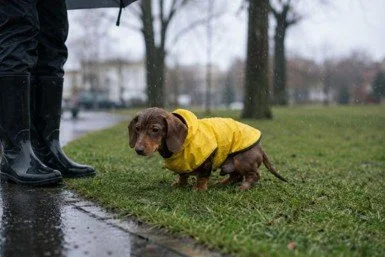
Some breeds handle weather fine from day one. Others (especially toy breeds and short-coated dogs) act like the rain is a personal insult. If your puppy refuses to go outside in bad weather, don't force a long session. Take them to their spot on leash, give the verbal cue, and wait two to three minutes. If nothing happens, go back inside, crate them for 10 minutes, and try again.
What you don't want to do is cave and let them go on a pad inside because it's raining. That creates a substrate preference problem. Your puppy learns that indoor surfaces are acceptable when conditions aren't perfect, and "not perfect" starts to include any day they'd rather stay on the couch.
Build weather tolerance gradually. Short outdoor play sessions in light rain or cold. A treat and praise for stepping outside willingly. Over a few weeks, most puppies stop caring about weather entirely.
One thing that helps in urban environments where outdoor access takes longer: carry your puppy to the potty spot if the walk involves stairs, elevators, or a long hallway. A puppy who needs to go right now can't make it through a five-minute building exit without an accident. Get them to the spot fast, then work with a training team that understands urban challenges if you need more targeted help.
Frequently Asked Questions About Puppy Potty Training
How long does puppy potty training realistically take?
Most puppies show major improvement within two to four weeks of consistent daily training. Full reliability, meaning zero indoor accidents without supervision, typically takes four to eight weeks. Smaller breeds often take longer because their bladders are physically smaller and they need more frequent trips outside. Full bladder control doesn't develop in most puppies until five to six months of age, so expecting perfection from a 10-week-old isn't realistic.
Why does my puppy keep having accidents even though we go outside?
The two most common reasons are not going out frequently enough and giving too much unsupervised freedom indoors. A 2024 APDT International survey identified owner inconsistency and lack of supervision as the top two causes of prolonged housetraining failure. If your puppy goes outside and doesn't eliminate, crate them for 10 to 15 minutes, then try again. Don't let them roam the house after a failed trip outside.
Should I use potty pads or train my puppy to go outside?
Outdoor training is more effective long-term for most owners. Potty pads teach your puppy that indoor surfaces are acceptable for elimination, which creates a substrate preference that's difficult to reverse later. Trainers on professional forums consistently report that pad-trained puppies take longer to transition to outdoor-only habits. The exception is apartment living with no quick outdoor access, where pads may be a temporary necessity.
Is it true that small breeds are harder to potty train?
Yes, and there's a physical reason. Toy and small breeds have smaller bladders and faster metabolisms, so they need to go more frequently. A Chihuahua puppy at three months old might need outdoor trips every 20 to 30 minutes during active periods, compared to 45 to 60 minutes for a Labrador the same age. The training method is identical. The schedule just needs to be compressed.
What should I do when my puppy has an accident inside?
If you catch them mid-act, calmly interrupt with a quick sound (not yelling), pick them up, and carry them to the outdoor spot. Reward them if they finish outside. If you find the accident after the fact, simply clean it with an enzymatic cleaner and move on. The ASPCA confirms that punishment after the fact creates fear and hiding behavior, not learning. Your puppy can't connect your anger to something that happened minutes earlier.
Why does my puppy go right after coming back inside?
This usually means you didn't stay outside long enough or the puppy was too distracted to focus on eliminating. Stay at the potty spot for at least five minutes. If they don't go, bring them inside, crate them immediately for 10 to 15 minutes, then go back out. Repeat until they produce results outside. Rewarding the outdoor success heavily with a high-value treat will speed this up.
When should I call a professional trainer for potty training help?
If you've been consistent for two to three months with no meaningful progress, or if a previously housetrained puppy suddenly regresses, consult a CPDT-KA or IAABC-certified professional. Sudden regression in a trained puppy can signal a medical issue (urinary tract infection, gastrointestinal problems), so a vet visit should come first. After medical causes are ruled out, a qualified trainer can identify environmental or behavioral factors you might be missing.