
If you've ever stood in the pet food aisle comparing two bags side by side, you've seen the word. Premium. Super premium. Ultra premium. It shows up on a large share of dry dog food bags, usually in heavy type on the front panel beside a photograph of meat and vegetables, and it carries real weight at the point of purchase.
It is also one of the few things on the package with no agreed definition. No pet food regulation sets out what a premium food must contain, and no independent body checks the claim before it is printed. The parts of the label that are defined, and enforceable, sit in small type on the back and side panels.
The term has no regulatory definition
US pet food labelling is governed at two levels. Federal rules under 21 CFR part 501, administered by the FDA, require that a label properly identify the product, state the net quantity, name the manufacturer or distributor, and list every ingredient. States add their own requirements, most of them modelled on the regulations published by the Association of American Feed Control Officials (AAFCO).
Nothing in either layer defines "premium". Consumer guidance summarising FDA's position has long put it plainly: foods described as premium or gourmet are not required to contain different or higher quality ingredients, and are not held to higher nutritional standards, than any other complete and balanced product.
There is no minimum protein figure attached to the word. No sourcing rule, no processing standard, no certification step, no third party verifying it. A manufacturer can print it on the front panel without changing anything in the formula behind it.
That sets it apart from terms on the same package that are defined. "Complete and balanced" may only appear when nutritional adequacy has been substantiated in one of the specific ways set out below. Organic claims fall under USDA National Organic Program certification. Even "natural", loose as it is, has an AAFCO definition that turns on the absence of chemically synthesised ingredients. Premium sits with "gourmet", "holistic" and "ultra": front-panel language, not label law.
What that means on the shelf
Because the word has no content, two bags that both carry it can differ in every respect that affects a dog.
Protein can come from a named muscle meat in one and an unspecified rendered blend in the other. Crude fat can differ by several percentage points, which changes the calorie density and the amount fed per day. One recipe can be grain free and heavy in legumes, the other a conventional chicken and rice formula. One can be substantiated by a feeding trial, the other on paper alone.
Price tracks the word loosely at best. Bags of similar weight carrying premium or super premium routinely span a wide price range in the same aisle, and no manufacturer is obliged to say what the designation refers to, because there is no defined difference to describe.
The parts of the label that are defined
Three elements of the package are specified, enforceable and genuinely comparable between products. All three sit on the back or side panel.
Guaranteed analysis
This is the nearest thing the bag has to a specification sheet. It states minimum crude protein, minimum crude fat, maximum crude fibre and maximum moisture, as percentages the manufacturer commits to and can be held to.
The figures cannot be compared straight across, because they are stated as fed and moisture content varies. Converting to a dry matter basis removes the water and makes two foods comparable: divide the as-fed percentage by the dry matter fraction, which is 100 minus the moisture percentage.
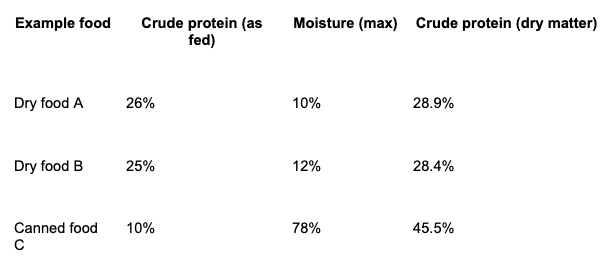
The two dry foods look a point apart on the front panel and are within half a point of each other in the bowl. The canned food looks far weaker and is in fact the most protein-dense of the three. Any comparison between wet and dry food that skips this step is meaningless.
One limitation is worth keeping in view: crude protein is a measure of nitrogen content, not of protein quality, digestibility or amino acid profile. A high figure says how much, not how usable.
Nutrient adequacy statement
This short sentence carries more information than anything on the front of the bag. It states whether the food meets an established AAFCO nutrient profile, for which life stage, and how that was established.
The recognised life stages are gestation and lactation, growth, adult maintenance, and all life stages, which must meet the more demanding growth requirements. Dog foods claiming growth or all life stages must also state verbatim whether the claim includes or excludes growth of large size dogs, defined as 70 pounds or more as an adult. That phrase exists because large-breed puppies are sensitive to excess calcium during skeletal development, and the profiles cap it more tightly for them. For anyone raising a large-breed puppy it is the single most consequential line on the package.
Substantiation comes in two forms, and the wording distinguishes them:
Formulated to meet the nutritional levels established by the AAFCO Dog Food Nutrient Profiles for [life stage]. The recipe meets the profile on paper or by laboratory analysis of nutrient levels.
Animal feeding tests using AAFCO procedures substantiate that [product] provides complete and balanced nutrition for [life stage]. The food was fed to dogs under a defined protocol and the animals were monitored throughout.
The second is the higher bar, because it tests whether the nutrients are actually available to the animal rather than simply present in the mix. It is also slower and more expensive, which is why most products on a shelf carry the first wording. A third variant states that a food is comparable in nutritional adequacy to a product substantiated by feeding tests, which relies on a family resemblance to a tested formula.
A product that carries no adequacy statement, or that says it is intended for intermittent or supplemental feeding only, is not formulated as a sole diet at all.
Ingredient list
Federal rules require ingredients to be listed by their common or usual name in descending order of predominance by weight. That order is informative, with two important qualifications.
First, the weights are taken as the ingredients go into the mix, water included. Fresh chicken is roughly two thirds water, so it can sit first on the list while contributing less finished protein than a rendered meal further down. Chicken meal has already had most of its water and fat removed, which makes a listing in third or fourth place more substantial than it looks.
Second, ingredient splitting shifts the order without changing the recipe. If peas, pea protein and pea fibre appear as three separate entries, each is weighed separately, and their combined contribution can exceed the meat listed above them. The same applies to rice, rice flour and rice bran, or to several named forms of the same grain.
Named sources such as chicken, lamb or salmon identify what the ingredient is. Collective terms such as meat and bone meal, animal protein products or poultry by-product meal are permitted under federal rules but describe a category rather than a species, which makes them harder to trace and less consistent between batches.
Why the term persists
Label claims that are specific can be challenged. A stated protein minimum can be assayed. A growth claim can be checked against a nutrient profile. Country-of-origin language falls under advertising rules.
An undefined adjective can be challenged by none of these, because it asserts nothing in particular. It is not a false claim in any legal sense; it is an absence of a claim, dressed in the vocabulary of one. That is a different problem from mislabelling, but it leaves the shopper in much the same position.
It survives because it does its job in the few seconds a bag gets on a crowded shelf. The word costs nothing to print, carries no substantiation burden, and reliably shifts perceived value. The incentive is straightforward, and most manufacturers using it are following the market rather than attempting to deceive anyone.
A repeatable way to compare two foods
The comparison takes about ninety seconds per bag and runs in the same order every time.
Nutrient adequacy statement. Confirm the life stage matches the dog, and for a puppy expected to exceed 70 pounds, check the large size growth wording. Note whether the food was formulated to the profile or substantiated by feeding tests.
Guaranteed analysis, converted to dry matter. Compare protein and fat on the same basis, not as printed.
Ingredient list. Look for named protein sources, judge where a fresh meat entry sits once its water content is accounted for, and watch for split ingredients.
Cost per day, not per bag. Divide the price by the number of days the bag feeds at the recommended amount for the dog's weight. Calorie-dense foods are fed in smaller portions, which can reverse an apparent price difference.
The process is easier where specifications are laid out in a consistent format across several brands at once, as in a retailer collection of premium dry dog food that presents guaranteed analysis and ingredient panels side by side rather than one bag at a time.
Run this way, the word on the front stops functioning as a variable. Some foods that use it hold up well. So do plenty that do not.
The bottom line
The word on the front of the bag is not a warning sign. It is simply not an answer. It carries no nutritional information, no sourcing commitment and no verification, and a food that uses it may be excellent or unremarkable.
The information that distinguishes one food from another is printed in small type on the side panel, in three places that are defined, enforceable and directly comparable once moisture is accounted for. Anyone choosing between two bags is better served by thirty seconds on the back of each than by the adjective on the front.
So next time you're standing in that aisle with two premium bags in hand, you'll know exactly where to look first — and thirty seconds on the back panel will tell you more than the word on the front ever could.